Laura Ruggeri
Database Opere
-
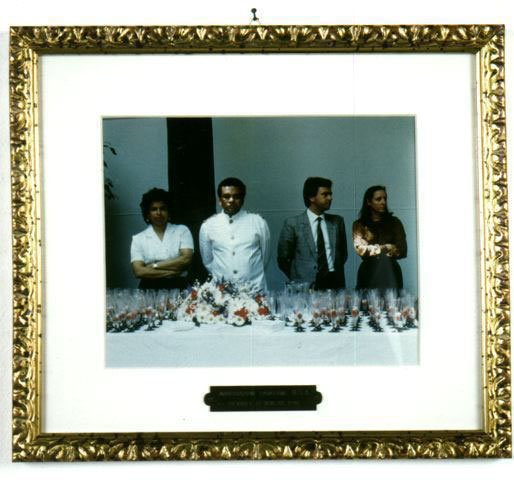
Padiglione americano Biennale di Venezia, 1990
Fotografia, cornice, targhettacm. 70 x 50“The gallery was transformed into a film set, where everybody played a role. The gallerist played ‘himself’, under 500 Watts quartz spotlights. Wearing a waitress uniform, I took the role of the drink waitress, and became “invisible” to the audience. The undeclared waitress performance was related to the projection in the next room. The projected image (4mx5m) was a photograph of the waiter and waitress who served drinks at the opening of the Venice Biennial 1990, in front of the American Pavillion. They were both Afro-Americans, a reinforcement of a classical American film stereotype. The audience’s shadows mingled with the projection, thus extending the “scene” off the wall and into the room. The soundtrack consisted of unauthorized recordings of all the openings I had attended during the year in public and private spaces. Past and present, real and staged openings overlapped, the viewer got disorientated.”
-
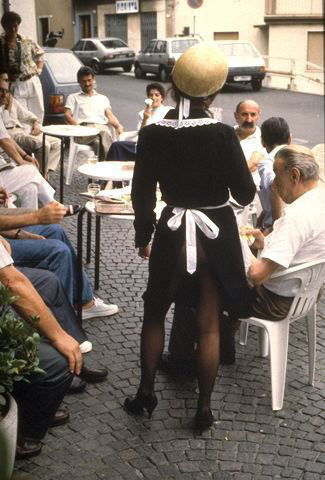
Waitress, 1991
Performance.
-

Sindone, 1991
Timbro su 2.000 tovaglioli di cartaAzione.
“Hundreds of paper napkins printed with FIAT logos, scattered on the floor and piled on the tables before the opening of a group show to suggest that the real party had already taken place, and left a big mess behind, FIAT style, business as usual in the area around Turin, regarded as private property of the car manufacturer.” -
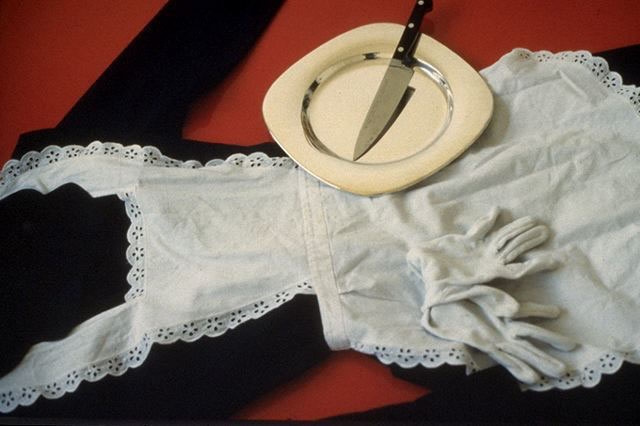
Manifesto, 1992
Cibachrome su alluminiocm. 100 x 70 -
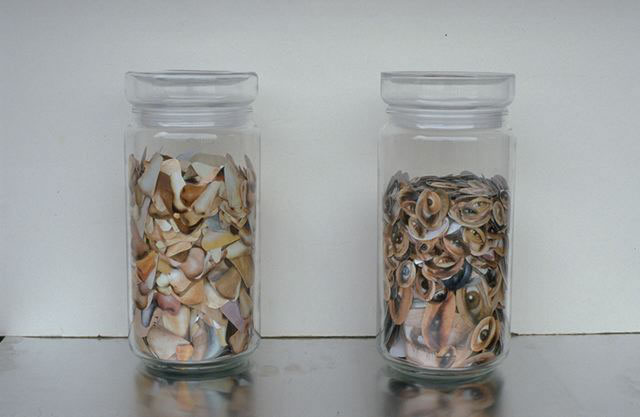
Collezione, 1992
Frammenti fotografici e contenitori in vetro“I never considered myself a photographer, I found the opportunity, unexpected and challenging, to think about the traditional function of photography, its power to record, reproduce and become an object in its own right. However I was not interested in the stylistic aspect, the “artistic” quality of photography. But what really disturbs me whenever I look at a picture is its unnatural stillness that makes it reminiscent of death. Rather than taking more photographs I decided to cut up the ones I took in the past (dissect instead of “killing”!) and then I distributed the fragments into five glass jars, one for each organ of the senses.”
-
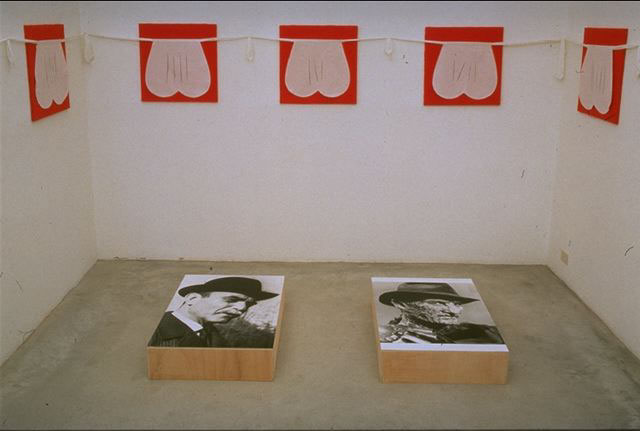
Il maestro è un mostro, 1993
Tecnica mistaInstallazione.
“Lucio Fontana (the master) and Freddy Kruger (the monster) are juxtaposed in an intertextual practice aimed to point out the symbolic implications of the famous cuts. Being a long date fan of the horror film series “Nightmare” I had found a striking resemblance between Fontana’s and Kruger’s features, a resemblance reinforced by the similarity of their gestures of slashing. In addition I had discovered in Fontana’s correspondance that he was a misogynist, and often referred to his famous cuts as “cunts”.” -
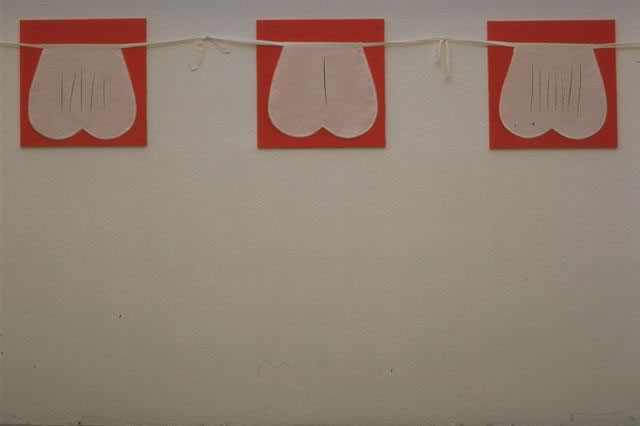
Il maestro è un mostro, 1993
Tecnica mistaParticolare dell’installazione.
“All along the walls of the gallery 16 waitress aprons were tied to one another, on each one of them Fontana’s cuts were printed. I didn’t want to repeat the aggressive gesture, but just to suggest it. The choice of aprons referred to my previous performance as a waitress and also to a male sexual fantasy.
A 30 min. video was also made cutting up and editing the series “Nightmare”, choosing only the scenes where Freddy performs the famous slashes with his sharp glove. On a night table were three silver framed photographs (10x15cm) of Lucio Fontana, the glove, and Freddy Kruger.” -

Nightmare, 1993
Tre stampe b/n incorniciatecm. 10 x 15 ciascunoOpera da comodino.
-
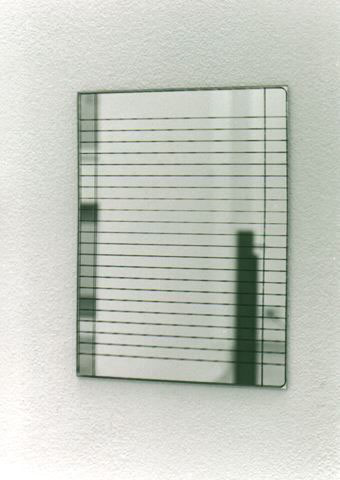
Io rifletto, 1993
Serigrafia su specchiocm. 20 x 13,5“12 mirrors, the format and size of a lined exercise book were distributed at various points of the gallery in order to reflect the works of all the other artists. Both writing and looking at oneself in the mirror are relevant experiences in recognizing one’s identity. My mirrors receive between their own lines the visions of others, focusing on the continuous exchange of views that the work of art sets up and requires. The often self sufficient position of the artist is regarded as narcissistic.”
-
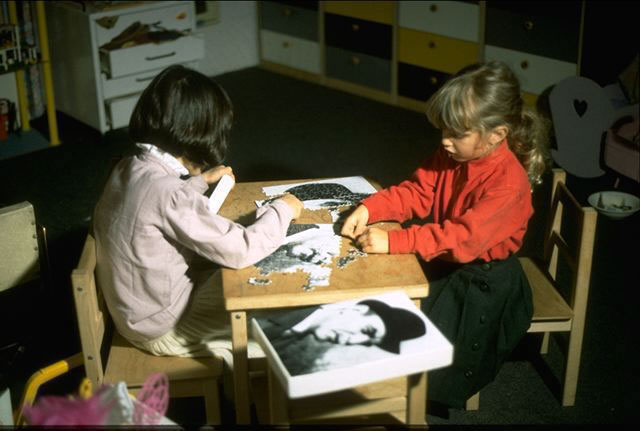
Il maestro è un mostro, 1994
Puzzle“I created a space where kids could play with two jigsaw puzzles representing Fontana and Kruger. By playing with the master and the monster they would, maybe, learn how to play down their fears of both.”
-
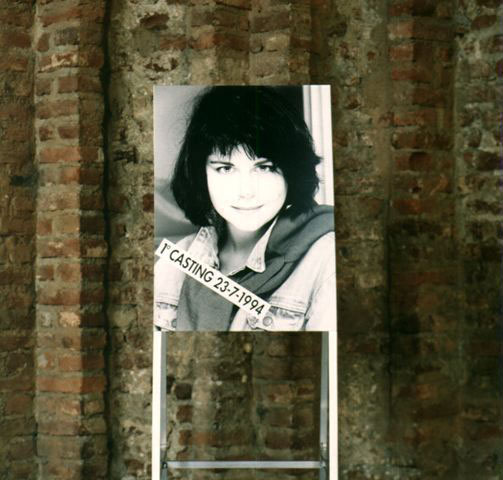
Casting, 1994
Azione.
“A quest for someone willing to take my place as an artist; the project consisted in organising a casting inside the museum, after putting ads on national and local newspapers’ classifieds. Seven women, vaguely resembling me, showed up, but none of them accepted to be an artist for a whole year.” -
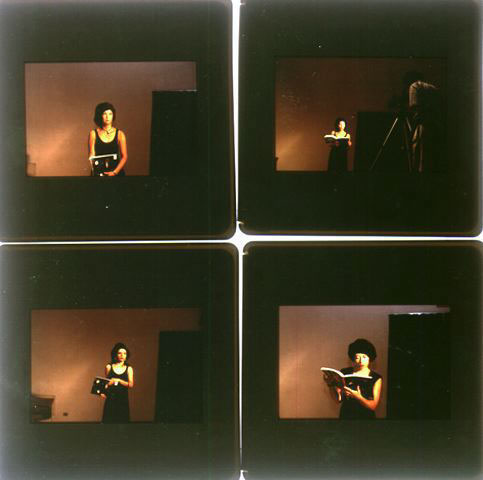
Casting, 1994
Azione.
“A quest for someone willing to take my place as an artist; the project consisted in organising a casting inside the museum, after putting ads on national and local newspapers’ classified. Seven women, vaguely resembling me, showed up, but none of them accepted to be an artist for a whole year.” -
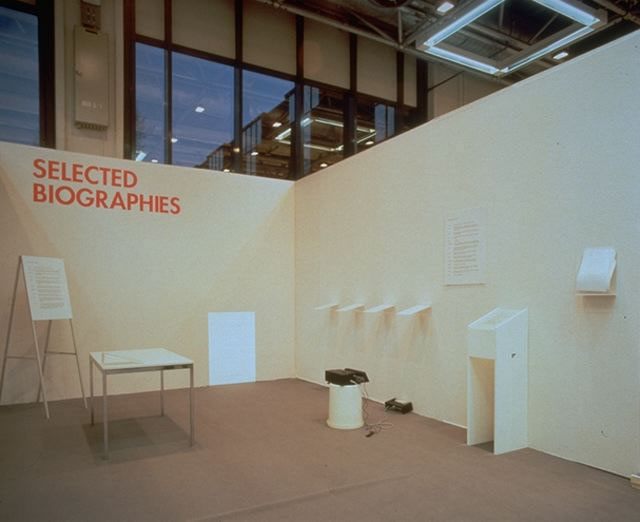
Selected biographies, 1994
Installazione.
“I asked some non artists friends, to write their biographies according to the model used in art books and museums, being aware that the presentation and the packaging are essential parts of art itself. This traditional use of informational modes made the viewer believe those were artists’ biographies, despite the absence of any art works. It was the viewer expectation that made any episode of their lives relevant; a divorce, social and political involvement, the birth of a child, mental troubles, events that might occur to everyone, but stated in a museum mount become somehow exceptional. I collected about twenty biographies and displayed them in plexiglass, wood plinths, frames, slide projections, pamphlets, panels, leaflets…” -
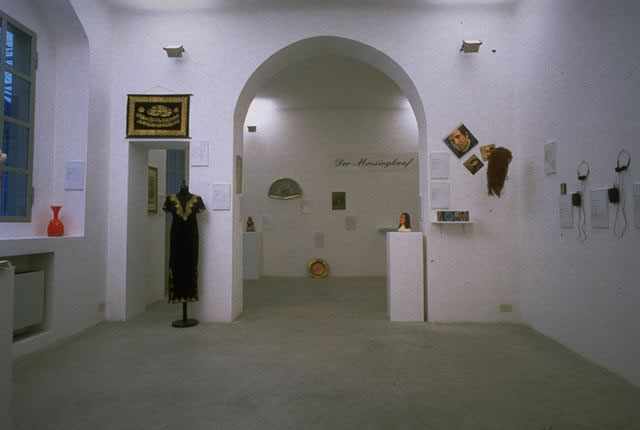
Der Messingkauf, 1995
Mostra realizzata in collaborazione con gli inquilini del condominio di Viale Bligniy 42, dove ha sede la galleria.
Ho chiesto a tutte le persone di prestare un oggetto alla galleria e compilare una scheda di prestito, che in mostra viene esposta accanto al relativo oggetto. In questo modo ho voluto imitare il protocollo museale per il prestito, coinvolgere e connettere alla galleria un contesto usualmente escluso, creando una diversione rispetto alle abituali relazioni tra galleria, collezionista e critico. Il valore di ogni pezzo non era prefissato, ma determinato dalla relazione; come nel sistema dell’arte contemporanea il valore e il significato di un lavoro sono il risultato di una interazione. Il titolo Der Messingkauf deriva dagli scritti sul teatro di Bertolt Brecht ed è relativo alla inappropriatezza di valutare ogni cosa in termini monetari. -
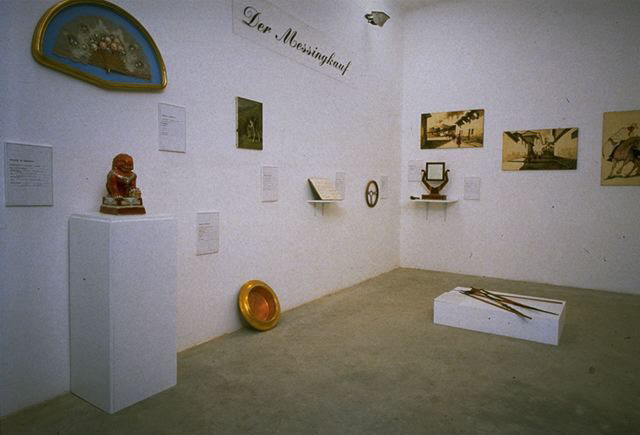
Der Messingkauf, 1995
Particolare dell’installazione: in mostra, oggetti prestati dagli abitanti del palazzo dove ha sede la galleria.
“An exhibition realised in cooperation with the inhabitants of Viale Bligny,42, where the gallery is located. I asked the tenants to lend an object to the gallery, and fill a loan form that was exhibited next to it. In this way I mimicked the museum protocol for loans. I involved and connected to the gallery a context usually excluded , creating a diversion from the usual relationship between artist, gallery, collector and critic. The value of each piece was not prefixed, but determined by the relation; like in the contemporary art, the value and the meaning of an artwork are the result of a collective interaction. The title “Der Messingkauf” has been found in Bertolt Brecht’s writings on theatre and relates to the inappropriateness of measuring everything on monetary terms.” -
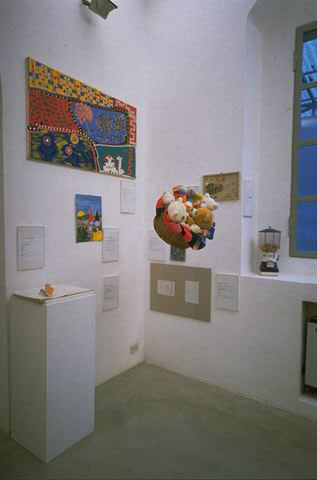
Der Messingkauf, 1995
Particolare dell’installazione: in mostra, oggetti prestati dagli abitanti del palazzo dove ha sede la galleria.
“An exhibition realised in cooperation with the inhabitants of Viale Bligny,42, where the gallery is located. I asked the tenants to lend an object to the gallery, and fill a loan form that was exhibited next to it. In this way I mimicked the museum protocol for loans. I involved and connected to the gallery a context usually excluded , creating a diversion from the usual relationship between artist, gallery, collector and critic. The value of each piece was not prefixed, but determined by the relation; like in the contemporary art, the value and the meaning of an artwork are the result of a collective interaction. The title “Der Messingkauf” has been found in Bertolt Brecht’s writings on theatre and relates to the inappropriateness of measuring everything on monetary terms.” -
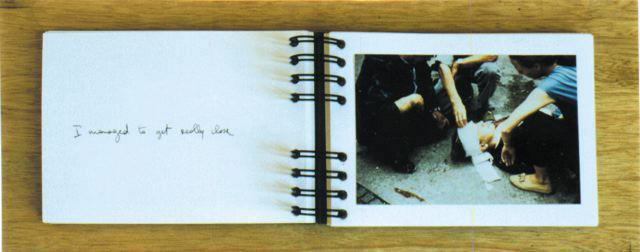
As a tourist, 1996
Foto-album“The photograph was taken a few minutes after an “accident” had occured to a young woman, as I was walking across Alexanderplatz, in Berlin. The picture is undeniably ‘dramatic’, and the effect is magnified by its cropping and composition, two men and a woman are bending over the unconscious body in a triangular disposition that is reminiscent of the Renaissance conventional “Pietà”. One cannot infer the causes of the accident from the picture, I, as a tourist, couldn’t either. Blowing up the photograph didn’t help, it just made it more spectacular but equally reticent. I started questioning the tourist’s gawk , the desire to consume and appropriate no matter what, no matter why, the more uncanny the better.
A caption referring to this picture can be found in a small photo-book, dating 1990, from which most pictures have been removed, leaving only brief descriptions of places visited or people met during my Berlin tour.” -
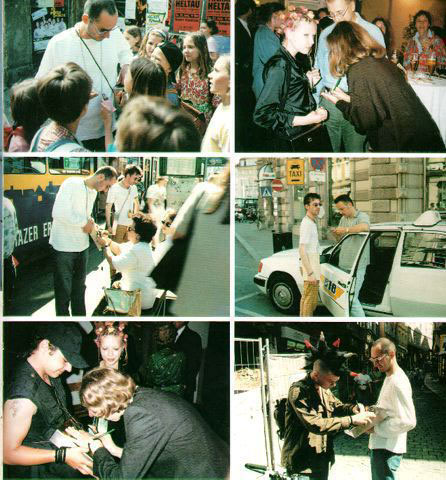
Wunschsammlung, Graz, 1997
Sono portate in giro una serie di scatole in acciaio lucente, fatte per contenere i desideri segreti delle persone, per raccogliere ciò che non potrà mai essere visto né conosciuto.
-

Monocromi, 1997
Acrilico su tela, computer, CD player2 tele“A black monochrome is designed to answer questions about the past, a white one about the future. They are hung in a small room, painted in the color of caucasian skin. Unlike what happens in museums, you are invited to touch the canvas, as if it were an interface, you can pose questions about anything. An electronically controlled system provides answers at random, choosing between three options:”Yes”, “No”, “Maybe”. As art exhibitions tend more and more to create a spectacular space, satisfying the demand for skin-deep entertainment and immediate, emotional gratifications, I trasformed abstract painting (the ultimate intellectual experience) into a funfair attraction that elicits a irrational, superstitious behavior, moving from the optical to the tactile apprehension.The nature of interactive systems, actually imposing a binary code, the will to believe and the fictionalization of history (you can ask questions about your past!) are also called into question. More and more messages and signs are presented to us as a question/answer …Tests and referendums are perfect forms of simulation: the question induces the answer, it is design- ated in advance … The object today is no longer “functional” in the traditional sense of the term; it doesn´t serve you, it tests you.“
-
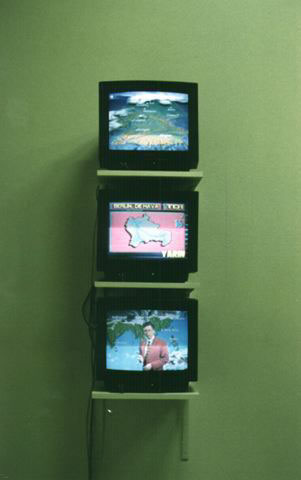
Weather report, 1997
3 monitor, timer, previsioni del tempo“At a set time three tv screens start broadcasting weather reports in different languages, a very loud babel that lasts only for a few seconds, an assault disturbing any activity people might be involved in. In Italian “tempo” means both weather and time, an important connotation that gets lost when we translate it in another language, a legacy of a pastoral and agricultural world, when the use of time depended largely on weather conditions.”
-

Abstract tour operator, 1997
Progetto per Berlino: Part 1: Schlossplatz, Part 2: Künstlerhaus Bethanien, Berlino. Per un mese ho curato una agenzia di viaggi in un container collocato nel centro di Berlino. Ho distribuito delle mappe e invitato la gente a scegliere forme geometriche tra quelle offerte e a gettarle sulla mappa della città. I risultanti itinerari astratti dovevano essere esplorati cercando di aderire il più possibile alle linee immaginarie, scalando muri o oltrepassando proprietà private. Come artista non guidavo i tours, ma sollecitavo una pratica sociale, un punto critico nel ciclo di produzione e consumo delle attrazioni turistiche. La Land Art aveva funzionato come progetto per una esperienza attiva della città.
Tutte le persone partecipanti sono state invitate alla mostra finale a presentare video, fotografie, note e oggetti sul tour realizzato. -
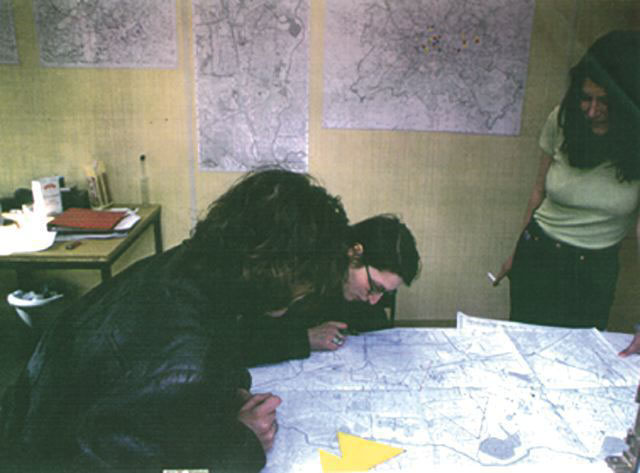
Abstract tour operator, 1997
Particolare.
-
Abstract tour operator, 1997
2 teleParticolare.